If you enjoyed "Spring and Fall: To a Young Child," check out my first orchestral piece, "Back Brook."
It's really slow and full of gooey textures. The title comes from this little creek behind my elementary school whose actual name was Back Brook. Because, you know, it was out back. Behind the school. I have fond memories looking for bugs and plants and stuff there. It held a sort of mystical quality for me because even though it was very shallow, you were never allowed to cross it. I have yet to travel to the far bank, though I'm pretty sure it just leads to the soccer fields by the middle school.
Definitely leave comments on the piece below!
Tuesday, May 17, 2011


Friday, May 13, 2011
Music at the Edge of Intellect - Eldar Djangirov and Vijay Iyer at the McCarter Theater
I just strolled back up campus from the aforementioned show in a pretty good mood. Vijay and his trio (with Tyshawn Sorey sitting in for Marcus Gilmore on drums) had a very satisfying set. It was full of rhythmic playfulness, the kind where you bob your head to some undiscernible underlying pulse. Moods swung from meditative and brooding to blissfully cathartic. Iyer, Sorey and bassist Stephen Crumb are on another plane musically. They privileged the audience with a brief look into their rhythmic wonderland.
So, um, what did I think of Eldar's opening set?
How can I put this lightly...
The old folks behind me seemed to enjoy it a lot :)
I on the other hand had a bit more difficulty. As a preface for what is to come, I was enamored by Eldar last time I saw him. I was sixteen going on seventeen. Naive, timid, and scared was I, though with budding jazz chops. He just played so fast and in 7 and I just thought, "Wow he's only 19! This is so nuts." I of course sheepishly got an autograph afterward and awkwardly commented on his stuff in 7.
 The first instinct that a lot of my friends and I have about Eldar is that his virtuosity is just a novelty. It's impressive, a good bit of showmanship, and the audience usually responds as such (tonight was no exception). But even as a stingy, artsy music snob, I usually react well to good showmanship. Jazz has been filled with expert showmen like Oscar Peterson, Buddy Rich, Dizzy Gillespie, and Papa Jo Jones (please comment with anyone I left out), dating all the way back to Louis Armstrong. The inimitable Roots (they're a jazz band in my book) continue this tradition every night on Jimmy Fallon's show. But tonight, I didn't get any feeling of showmanship from Eldar. His virtuosity is eerily unselfconscious. I feel that what he played tonight is his own honest music. Yet after all of his hyperactivity and machine gun phrasing, I was left cold, dozing off in the heat of battle.
As I walked back tonight, I thought about the reason for this disconnect. I'm not usually the one coming out of a concert thinking I just didn't get it. This was a really weird feeling. After a good ponder, I feel Eldar's music is something like jazz with Asperger's (ok, I did think of jaszperger's, but that seems like unfair cheap shot). The virtuosity and ease of his playing is savant-like, seemingly beyond what any other human can do. However, the music lacks the nuance that makes emotional expression and recognition possible. It all comes off as a rote exercise in musical recall.
Eldar's so-cerebral-it's-scary music is an interesting foil for Vijay and his trio. Iyer is potentially the sharpest guy in the jazz world, or at least the most over-educated (BA in physics and math from Yale, MS/PhD from Cal Berkeley. Really says a lot coming from me huh. Ba dum crash.) Annnnnnyway...
I'm just saying that one would think Iyer's music would be the one that suffers from intellectual incomprehensibility, rather than Eldar's. His music can be pretty heady, like the third tune from tonight's show, called "Cardio." It starts off in this really fast 3+4 pattern that feels like it's in 2 but with beats of slightly different lengths. Then they layer groups of 5 and 6 beats on top of it. Sounds like a rhythmic morass, doesn't it?
But to be totally honest, I wasn't really paying attention to all that rhythmic stuff. I only figured it out after talking to the trio in the lobby. In the moment, I was dialed into the slippery groove. The piece built up gradually, gathering tension as notes flew by in ever-denser clusters. And suddenly, Tyshawn burst the musical knot open with a thundering cymbal crash followed by a riveting drum solo. The piece's complex mathematical time signature wasn't what made it engaging. Instead I like to think the performance was great despite the complex clave. Vijay, Stephen, and Tyshawn are so secure in their rhythmic feel that they can play the piece with total commitment, nuance, and flexibility. In the end, "Cardio" and the rest of the trio's set brimmed with vital communicative power. Call it passion, call it soul, call it whatever you want. You just know it when you hear it and when you hear it, it feels pretty good.
So, um, what did I think of Eldar's opening set?
How can I put this lightly...
The old folks behind me seemed to enjoy it a lot :)
I on the other hand had a bit more difficulty. As a preface for what is to come, I was enamored by Eldar last time I saw him. I was sixteen going on seventeen. Naive, timid, and scared was I, though with budding jazz chops. He just played so fast and in 7 and I just thought, "Wow he's only 19! This is so nuts." I of course sheepishly got an autograph afterward and awkwardly commented on his stuff in 7.
 The first instinct that a lot of my friends and I have about Eldar is that his virtuosity is just a novelty. It's impressive, a good bit of showmanship, and the audience usually responds as such (tonight was no exception). But even as a stingy, artsy music snob, I usually react well to good showmanship. Jazz has been filled with expert showmen like Oscar Peterson, Buddy Rich, Dizzy Gillespie, and Papa Jo Jones (please comment with anyone I left out), dating all the way back to Louis Armstrong. The inimitable Roots (they're a jazz band in my book) continue this tradition every night on Jimmy Fallon's show. But tonight, I didn't get any feeling of showmanship from Eldar. His virtuosity is eerily unselfconscious. I feel that what he played tonight is his own honest music. Yet after all of his hyperactivity and machine gun phrasing, I was left cold, dozing off in the heat of battle.
As I walked back tonight, I thought about the reason for this disconnect. I'm not usually the one coming out of a concert thinking I just didn't get it. This was a really weird feeling. After a good ponder, I feel Eldar's music is something like jazz with Asperger's (ok, I did think of jaszperger's, but that seems like unfair cheap shot). The virtuosity and ease of his playing is savant-like, seemingly beyond what any other human can do. However, the music lacks the nuance that makes emotional expression and recognition possible. It all comes off as a rote exercise in musical recall.
Eldar's so-cerebral-it's-scary music is an interesting foil for Vijay and his trio. Iyer is potentially the sharpest guy in the jazz world, or at least the most over-educated (BA in physics and math from Yale, MS/PhD from Cal Berkeley. Really says a lot coming from me huh. Ba dum crash.) Annnnnnyway...
 |
| So what's going through Mr. Iyer's big brain? Does it really matter? |
 |
| The big guy with the little drum set |
Friday, May 6, 2011
New Jazz for You - Gerald Clayton, Adam Cruz, and Jeremy Udden's Plainville
Gerald Clayton - Bond: The Paris Sessions (Decca)
Clayton is a new breed of young lion. As the youngest in a prominent jazz family (his father John is a bassist and bandleader and uncle Jeff plays reeds), Gerald has prodigious chops and an intimate relationship with jazz tradition. But he's no brooding neoclassicist. If his wild dreds and long tie-with-jeans getup don't make that clear, his music certainly will.
Clayton's new album "Bond: The Paris Sessions" opens with the cliched standard "If I Were a Bell." It's a move that would seemingly send younger listeners packing, but Clayton pulls it off with a slick little groove that allows him to phrase the melody in unexpected ways. Bassist Joe Sanders and drummer Justin Brown relish the space in between Clayton's chords, bathing the tune in quiet busyness. In just under 8 minutes, the trio presents a fresh and urbane view of jazz that updates oft-used methods with a distinct rhythmic crackle.
With this emphasis on rhythm, it makes sense that the trio has a thing for vamps. Almost every tune has one, allowing the band to show off its immense vocabulary of rhythmic tricks. All three musicians are under 30, but they've been playing with each other in various groups since their teenage years. They know each others' tendencies so well that they seem to communicate in a tri-composed monologue rather than a friendly conversation. While the album's emotional gamut runs only from pensive to cool, there's a lot to enjoy - Sanders' effortless counter-lines, Brown's snappy snare accents, Clayton's deft touch. Gerald Clayton's city-slick jazz has a vital pulse and plenty of avenues left to explore.
"Bond: The Paris Sessions" comes out on May 10
Adam Cruz - Milestone (Sunnyside)
Gerald Clayton has now produced two full-length albums before his 27th birthday. On the other hand, drummer Adam Cruz has taken quite a bit longer just to get through one (he's just over 40). That doesn't mean Cruz isn't one of the busiest musicians in New York. Cruz is one in-demand sideman, playing with the jazz-famous likes of saxophonist Chris Potter, pianist Danilo Perez, and the almost-actually-famous Chick Corea. Cruz can lay down swing, funk, and Latin grooves (plus any combination thereof) with equal aplomb, but has yet to step out as a bandleader and composer until now.
The results on his appropriately-named debut "Milestone" are mixed at best. It's not because of a lack of musicianship - Cruz has assembled a crack band including Potter, MacArthur-winning saxophonist Miguel Zenon, versatile guitar ace Steve Cardenas, and Cruz's longtime rhythmic foil Ben Street on bass. The performances are all solid, but lack a certain spark. It has all the hallmarks of the past decade's mainstream jazz - driving Latin-ish vamps, knotty melodies, complex non-functional harmonies, lots of room for the soloists to blow.
Although Cruz's chameleon-like flexibility and unyielding tastefulness make him an ideal supporting actor, they're a bit of a liability now that he's taken a leading role. He lets his partners be themselves, instead of challenging them with new musical contexts in which to improvise. Though many of the tunes have multiple sections, few have an engaging and dramatic arc. There certainly are some good moments on the album, like the sax battle on "Gadfly" and Cardenas' tropical pluckings on "Outer Reaches." Unfortunately, the compositions can't sustain the momentum of these moments, yielding an album that sounds surprisingly typical.
"Milestone" was released on April 12
Jeremy Udden's Plainville - If the Past Seems So Bright (Sunnyside)
If Brooklyn has been too-oft described as a musical Eden with diverse genres sharing the same lush pastures, its only because the myth is too often confirmed by yet another great genre-blowing album from a Brooklynite. This month's album is "If the Past Seems So Bright" from the saxophonist Jeremy Udden and his band Plainville.
No matter who your favorite hipster band is, you'll find something to like here. Wilco fans will fawn over the layered electronic pianos and distorted guitars. Disaffected Sufjanistas will go giddy at the sound of gently arpeggiated banjos. Fleet Foxes fanatics will float along with the gently harmonized folk melodies.
But "If the Past..." isn't great because of its similarities to good 'n folksy indie rock. It's more like it's great despite those similarities. It's not like, you know... hmm... some... exhilarating pastiche. Instead, Plainville has a strong musical identity that melds the disparate personalities of its members into a sturdy whole. Udden has a pleasing, woody tone on his various saxophones, imbuing the simple melodies with vocal honesty. Guitarist/banjoist Brandon Seabrook and keyboardist Pete Rende create a rustic and immersive soundscape, using a color palette of diverse instruments and effects pedals. And all along, bassist Elvind Opsvik and drummer R.J. Miller ground the music in a time feel that breathes with perfectly-placed imperfections.
The album is bracingly analog, a blurred photograph, a letter from your ancestor, so real you can taste it. The stark opening drum beats transport you to a world of deep memory, and you remain there long after the last guitar fades.
"If the Past Seems So Bright" comes out on May 31.
Clayton is a new breed of young lion. As the youngest in a prominent jazz family (his father John is a bassist and bandleader and uncle Jeff plays reeds), Gerald has prodigious chops and an intimate relationship with jazz tradition. But he's no brooding neoclassicist. If his wild dreds and long tie-with-jeans getup don't make that clear, his music certainly will.
 |
| Lookin' sharp, Gerald |
With this emphasis on rhythm, it makes sense that the trio has a thing for vamps. Almost every tune has one, allowing the band to show off its immense vocabulary of rhythmic tricks. All three musicians are under 30, but they've been playing with each other in various groups since their teenage years. They know each others' tendencies so well that they seem to communicate in a tri-composed monologue rather than a friendly conversation. While the album's emotional gamut runs only from pensive to cool, there's a lot to enjoy - Sanders' effortless counter-lines, Brown's snappy snare accents, Clayton's deft touch. Gerald Clayton's city-slick jazz has a vital pulse and plenty of avenues left to explore.
"Bond: The Paris Sessions" comes out on May 10
Adam Cruz - Milestone (Sunnyside)
Gerald Clayton has now produced two full-length albums before his 27th birthday. On the other hand, drummer Adam Cruz has taken quite a bit longer just to get through one (he's just over 40). That doesn't mean Cruz isn't one of the busiest musicians in New York. Cruz is one in-demand sideman, playing with the jazz-famous likes of saxophonist Chris Potter, pianist Danilo Perez, and the almost-actually-famous Chick Corea. Cruz can lay down swing, funk, and Latin grooves (plus any combination thereof) with equal aplomb, but has yet to step out as a bandleader and composer until now.
 |
| Cruz doing what he does best - just layin' it down |
Although Cruz's chameleon-like flexibility and unyielding tastefulness make him an ideal supporting actor, they're a bit of a liability now that he's taken a leading role. He lets his partners be themselves, instead of challenging them with new musical contexts in which to improvise. Though many of the tunes have multiple sections, few have an engaging and dramatic arc. There certainly are some good moments on the album, like the sax battle on "Gadfly" and Cardenas' tropical pluckings on "Outer Reaches." Unfortunately, the compositions can't sustain the momentum of these moments, yielding an album that sounds surprisingly typical.
"Milestone" was released on April 12
Jeremy Udden's Plainville - If the Past Seems So Bright (Sunnyside)
If Brooklyn has been too-oft described as a musical Eden with diverse genres sharing the same lush pastures, its only because the myth is too often confirmed by yet another great genre-blowing album from a Brooklynite. This month's album is "If the Past Seems So Bright" from the saxophonist Jeremy Udden and his band Plainville.
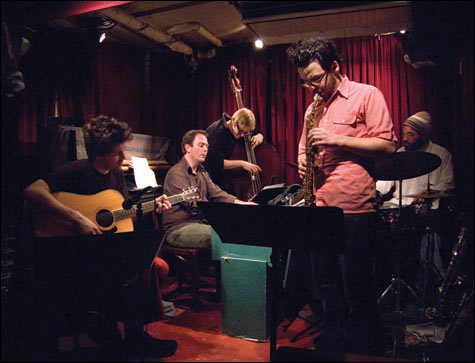 |
| Udden and the gang in action |
But "If the Past..." isn't great because of its similarities to good 'n folksy indie rock. It's more like it's great despite those similarities. It's not like, you know... hmm... some... exhilarating pastiche. Instead, Plainville has a strong musical identity that melds the disparate personalities of its members into a sturdy whole. Udden has a pleasing, woody tone on his various saxophones, imbuing the simple melodies with vocal honesty. Guitarist/banjoist Brandon Seabrook and keyboardist Pete Rende create a rustic and immersive soundscape, using a color palette of diverse instruments and effects pedals. And all along, bassist Elvind Opsvik and drummer R.J. Miller ground the music in a time feel that breathes with perfectly-placed imperfections.
The album is bracingly analog, a blurred photograph, a letter from your ancestor, so real you can taste it. The stark opening drum beats transport you to a world of deep memory, and you remain there long after the last guitar fades.
"If the Past Seems So Bright" comes out on May 31.
Wednesday, April 27, 2011
My Most Important Influences
Part of the reason for my semi-hiatus from blogging this semester is the fact that I've been doing a lot of composing. Through an orchestration class with composer Steve Mackey, a tour of Estonia with the university Jazz Composers' Collective, and a junior composition project, I've put more ink on paper during these last 3 months than I've probably put down in my life so far. Up until now, I've considered myself a player who dabbles in composition, mostly as an alternative to playing cheesy jazz standards. But after spending more time musing and notating, I feel more confident in expressing the sounds I like on paper in some form.
With a week of classes left, I've gotten to a point where I think I'm finding some sort of musical personality. There are gestures and soundworlds to which I seem to gravitate. I now say that I have a musical philosophy (in a nutshell it says that music itself communicates very little, but there needs to be something in it, usually a sound, that engages the listener and prompts him or her to bring metaphorical meaning to bear. Ok that was a long parenthetical comment). Anyways, along with this thought of personality comes thoughts of influences. Especially in my junior project (a setting of Gerard Manley Hopkins' "Spring and Fall: To a Young Child"), I can probably identify like 50 tracks on my computer from which I lifted some small gesture or sound. I know that real music critics hate people that describe music as a combination of some other artists, but I'm going to do it anyway. Below is a list of artists and a track of theirs that seem to have seeped into my aesthetic in some way. Maybe the list will make you listen to my JP a little differently.
Aaron Parks - "Peaceful Warrior"
Alex Cline - "Nourishing Our Roots"
The Bad Plus - "Prehensile Dream"
David Lang - "The So-Called Laws of Nature"
Barenaked Ladies - "Brian Wilson"
Bela Fleck - "The Whistle Tune"
Ben Monder - "Ellenville"
Bill Frisell - "Gimme' a Holler"
Billy Bragg & Wilco - "Remember the Mountain Bed"
Bob Dylan - "Like a Rolling Stone"
Bobby Previte - "The 23 Constellations of Joan Miro"
Brad Mehldau - "Goodbye Storyteller"
Brian Blade Fellowship - "Crooked Creek"
Brian Eno - "Music for Airports I"
Charles Mingus - "Moanin'"
Chicago Underground Duo - "Blue Sparks from Her, and the Scent of Lightning"
The Claudia Quintet - "Crane Merit"
Gustav Mahler - Last movement of Symphony no. 3
Aaron Copland - Symphony no. 3
Darcy James Argue - "Phobos"
Dave Douglas - "Summit Music"
David Binney - "All of Time"
Samuel Barber - "Knoxville: Summer 1915"
Dirty Projectors - "Two Doves"
Django Bates - "Life on Mars"
Don Cherry - "Symphony for Improvisers"
Duke Ellington - "Happy Go Lucky Local"
Eric Dolphy - "Straight Up and Down"
Fleet Foxes - "Ragged Wood"
Fred Hersch - "Leaves of Grass"
Guillermo Klein - "Miula"
Herbie Hancock - "Actual Proof"
Jason Moran - "Blue Blocks"
Rebecca Fanya - "Superhero"
Jenny Scheinman - "Song of the Open Road"
Jim Black - "Maybe"
John Adams - "Dharma at Big Sur"
John Cage - "Third Construction"
John Coltrane - "Moment's Notice"
John Hiatt - "Have a Little Faith"
John Hollenbeck Large Ensemble - "A Blessing"
John Zorn - "Beeroth"
Joni Mitchell - "Hejira"
Joshua Redman - "Faraway"
Judy Collins - "Since You Asked"
Kate Bush - "This Woman's Work"
Keith Jarrett - "Koln Concert IIc"
Kenny Wheeler - "Sweet Time Suite"
The Kinks - "Strangers"
Kurt Elling - "Leaving Again"
Igor Stravinsky - The last 10 minutes or so of the Firebird Suite
Luciana Souza - "Tonight I Can Write"
Lyle Mays - "Alaskan Suite: Ascent"
Steve Reich - "Music for 18 Musicians"
Osvaldo Golijov - "Pasion Segun San Marcos"
Maria Schneider - "The Pretty Road"
Miles Davis - "Bitches Brew"
Wayne Shorter - "Fall"
Joseph Schwantner - "Percussion Concerto"
The New Pornographers - "Challengers"
Nick Drake - "River Man"
Norma Winstone - "Distance"
Oasis - "Wonderwall"
Ornette Coleman - "Lonely Woman"
Pat Metheny - "San Lorenzo"
Patricia Barber - "The Moon"
Paul Lansky - "Three Moves for Marimba"
Paul Motian - "9x9"
Paul Simon - "Born at the Right Time"
Respighi - "Pines of Rome"
REM - "Man on the Moon"
Radiohead - "Paranoid Android"
Jeanne Lee - "Newswatch"
Sam Sadigursky - "After Paradise"
Sarah Kirkland Snider - "The Stranger with the Face of a Man I Knew"
So Percussion & Matmos - "Shard"
Sonny Sharrock - "Promises Kept"
Stephen Schwartz - "All Good Gifts"
Stevie Wonder - "Golden Lady"
Sufjan Stevens - "Casimir Pulaski Day"
Frederic Rzewski - "Coming Together"
Ted Leo & the Pharmacists - "Biomusicology"
Terrence Blanchard - "Transform"
Todd Sickafoose - "Tiny Resistors"
The Velvet Underground - "Heroin"
Vijay Iyer - "The Color of My Circumference I"
Joe Zawinul - "A Remark You Made"
Wilco - "Via Chicago"
So what the hell does this all mean anyway? Is a musical aesthetic just a combination of previous musical experience?
Whatever.
Saturday, March 12, 2011
Pause and Remember for 5
Jazz drummer John Riley reports that famed traps-man Joe Morello passed away this morning at the age of 82.
Morello is easily one of the most heard jazz drummers of all time. He played in pianist Dave Brubeck's quartet from 1955 through 1968, bringing his subtle swing and impeccable touch to American college campuses and developing countries alike. Brubeck and Morello pioneered the use of asymmetrical time signatures in jazz, especially on Brubeck's best-selling 1959 album, "Time Out." The opening track, "Blue Rondo a la Turk," skips along with awkward yet infectious 2+2+2+3 pattern. Morello then gives a masterclass on how simple five-four time can be with his solo on the now universally-known "Take Five." After his time in the Brubeck group, Morello focused his energies on drum education. He was a technique guru and published his challenging warm-ups and exercises in a series of books called "Master Studies." He is a legend among hard core drummers of all styles and stripes for his flawless technique and willingness to pass on the tools of the trade to future generations.
When I was learning drum set in middle school, Joe was an important teacher and inspiration. Ok, I never actually had a lesson with him (even though he lived in New Jersey), but I listened to "Time Out" a lot and did my fair share of work from "Master Studies." At that time, my principle drum deity was Buddy Rich and so needless to say I was all about playing loud and fast. I had some recordings of Art Blakey and Max Roach, but their style seemed weak in comparison to the unyielding power of Buddy's single strokes behind a big band. Joe could easily keep up with Buddy in a pure speed contest which is likely what drew me to him. However, Joe had a much different touch and feel around the kit. Every tap was carefully placed and shaped. The listener wasn't beat over the head with how great his technique was.
His "Take 5" solo was particularly perplexing to me in that he used space. He literally stopped playing at certain points, then would repeat an idea, develop it more, move on to another. This kind of drum solo was from a conceptual standpoint totally different from Buddy's. It was a thread meant to lead the listener along rather than a tidal wave meant to impress the listener into submission. Joe's playing made me being to listen to drummers differently and appreciate touch and space. I don't think I would have had any interest in Paul Motian's playing with the Bill Evans trio (a massive touchstone for me now) if it wasn't for my time spent with Joe Morello on "Time Out."
I was a bona fide drum nerd by the time I was in eighth grade, at the occasional annoyance to my older brother - I couldn't stop talking about it when he drove me home from school. But I guess the annoyance ended up being a good thing when my brother's high school chemistry teacher mentioned that her husband played jazz drums after seeing my brother lead the school jazz band at an assembly. She said that her husband studied with this guy that lived in the area, but who had a pretty big career at some point. My brother mentioned that I was getting really into jazz drumming and they agreed it would be a cute idea to get me an autograph of this erstwhile famous drummer.
On Christmas morning that year, I opened a rather innocuous envelope from my brother and freaked out when I found a personalized, autographed photo of Joe Morello inside. It immediately went up on my dresser, and has sat there through my hours of practicing since then. I never ended up meeting Joe, but I did talk to my brother's chemistry teacher's husband about him. He said that Joe was enthused upon hearing of a young, aspiring jazz drummer and was happy to give a token of inspiration.
Even as his magnum opus "Take 5" becomes a well-worn musical artifact, emblematic of a time yet divorced from its makers, Joe Morello will linger as a legend among drummers he will never meet. His enthusiasm for for sharing music and knowledge still flows from his records, books, and even a little autograph.
Monday, March 7, 2011
Bebop Lines and Tight Rhymes
A couple of weeks ago, Kanye West and Mos Def crashed a gig by the pianist/keyboardist/hip hop's official jazz guru Robert Glasper and the Blue Note in Greenwich Village. Lupe Fiasco was already on hand as a special guest, meaning this gig would have filled Giants Stadium, let alone the Blue Note's airliner-thin interior. CiscoNYC has the record here.
After the planned set, Mssrs. Def and West got into some spirited freestyle battling. I'm not going to pretend to be some arbiter of the match (though Kanye can make an egotistical rant sound riveting). To be frank, it was the audience involvement, especially during Kanye's go, that got me thinking.
For the the Glasper originals that opened the show, the audience was as polite as you could be at a jazz show, quietly chatting, applauding at appropriate points, etc. Even with Chris Dave digging into a massive pocket on the drums, the audience seemed to treat the whole thing as a mere sonic appetizer. When Kanye began his freestyle, the audience was deeply engaged. There were big responses when he rhymed "urine" with "touring," used big words like "Illuminati," and threw in a chorus-ending reference to "Jesus Walks."
Throughout West's performance, I couldn't help but think how they related to a great bebop solo. In any great solo, the player throws out some licks that feel irresistibly impressive - filled with lots of notes, flying in and out of the key, ending in the screaming upper range - just like West's virtuosic way with words. A well-timed musical quote, like those used by the tenor saxophonist Dexter Gordon, can add a strong dose of humor as well. Considering that great jazz improvisers and great rap freestylers use the same improvisational techniques, the difference in contemporary audience response between a jazz solo and a piece of freestyle is jarring.
The easy answer for this discrepancy even within the Glasper gig is that young listeners haven't listened to much jazz at all and so impressive runs have no meaning to them. But then again, improvisation is well-received among the young, whether at a concert with Phish or the Roots or with the local party band that jams out over James Brown tunes. I think part of the audience response problem is the context in which people today here jazz the most - classy restaurants and concert halls. These two venues put a premium on manners and appropriate behavior, rather than letting the listener freely engage with the music by cheering or dancing.
If one moves hard-swinging jazz out of these venues and into basement rock clubs, the performance vibe skyrockets. A couple of years ago, I saw the saxophonist Joshua Redman at the Highline Ballroom, a club more inclined to more popular strains of music than what jazz is now. With most of the crowd on its feet scattered around the room, the unyielding groove of the band's two bass-two drum attack got bodies moving. And when Redman jumped into the saxophonic stratosphere (see 3:29 in the vid), there was a mighty cheer. Any listener will respond to great instrumental freestyle if there's no need for permission.
Wednesday, March 2, 2011
Digital Disappearance
Psst. Over here.
Yes you.
Don't make me speak louder.
So you know I've been in hiding for the past two months and cannot reveal my exact whereabouts. I've become a musical-guerrilla-partisan-mercenary, offering up my services to various groups bent on musical liberation. I have not been able to post here for fear that some may get the idea that I am not busy enough and will contact me for other jobs.
However, here are a couple of things that you can look forward here in the coming weeks:
This all I have time for now, but will report back soon.
Over and out.
Yes you.
Don't make me speak louder.
So you know I've been in hiding for the past two months and cannot reveal my exact whereabouts. I've become a musical-guerrilla-partisan-mercenary, offering up my services to various groups bent on musical liberation. I have not been able to post here for fear that some may get the idea that I am not busy enough and will contact me for other jobs.
However, here are a couple of things that you can look forward here in the coming weeks:
- A post on some new music by the guitarist Anders Nilsson
- Ike Sturm's "Jazz Mass" and sacred music in secular spaces (but for the moment, check this out)
This all I have time for now, but will report back soon.
Over and out.
Subscribe to:
Posts (Atom)