you can find my favorite 15 albums of the year here, at the esteemed Billy Hepfinger's blog, Tenth Avenue Music.
But before you click on over, here are a few other year-end awards, commemorating everything from the worst to the weirdest of the year.
EPIC FAIL album of the year: Herbie Hancock - The Imagine Project
After pulling off the upset of all upsets during the 2008 Grammy Awards, I guess Herbie Hancock felt he was musically invincible, that even a silly idea like playing pop tunes with famous people around the world would turn into an epoch-defining album. Well, he did that, and it was just as terrible as one would think. I couldn't get through Seal and Pink singing the most ponderous version of "Imagine," well imaginable, before laughing in pain.
Honorable mention: Brad Mehldau - Highway Rider
It was ambitious, risky, and messy (which I usually like, see linked list), but it never got airborne. Mehldau is better with fewer people around him, not more.
Albums that probably would have made my list if I had actually heard them:
Steve Coleman & the Five Elements - Harvesting Semblances and Affinities
Chris Lightcap's Bigmouth - Deluxe
Geri Allen - Flying Toward the Sound
Myra Melford's Be Bread - The Whole Tree Gone
Jason Adasiewicz - Sun Rooms
Sharpest Dressed Performer - The JACK Quartet, Bang on a Can Marathon
Some very classy pastels belied the intensity of their performance of Xenakis' Tetras. I then saw one of them go into Banana Republic after the hit.
Honorable Mention - Darcy James Argue at Cafe Oto
He's upgraded from baggy jeans and dark t-shirts to a garish silver vest. Just needs to get matching ones for the band :P
Most Absurd Orchestral Moment - The opening three minutes of Marc Anthony Turnage's "Hammered Out" at the BBC Proms
He liked it and put a ring on it.
Honorable Mention - The New York Philharmonic performing Magnus Lindberg's "Kraft"
It's nice to see the notoriously crochety ensemble (they still haven't played a note of Phillip Glass!) take on a piece that requires the percussion section to go to a junkyard and then hang gongs from the ceiling.
Thursday, December 30, 2010


Tuesday, December 14, 2010
Doubleplusunbad
The esteemed jazz critic of the New York Times, Mr. Nate Chinen, is hosting a virtual year end round table at his blog, TheGig. Chris Barton, jazz critic of the Los Angeles Times, has some interesting thoughts about the Bad Plus, or more specifically, why they aren't talked about the same way, ten years after their debut album.
I'm definitely with Chris on how potent the Bad Plus are at this point. I saw them here in London during the jazz festival (twice for good measure) and I think my jaw was in some drooped position for 90% of the show (during the other 10% it was resting). There are few things in this life more pleasurable than watching Dave King drum.
But in terms of the Bad Plus in musical media right now, at least part of it seems to be how people responded to them when "These are the Vistas" came out. Most all of the reviews concentrated on the novelty of the covers, whether they thought it was good or bad. Even the ads for the show in London mentioned those early reviews and described the band in those terms - post-modern jazz trio, as fun as highbrow gets. By it's nature though, the novelty narrative dries up pretty quickly.
I feel (and Ethan & co. correct me if I'm wrong) that the band is so much more than "Heart of Glass" and have preferred to explore their many musical interests, rather than developing their image and touring with semi-big rock acts (something that Medeski, Martin & Wood did when they opened for Phish). The Bad Plus jumped off a major label anyway, which gives them a lot more musical freedom and the ability to more organically affect how people view them. They may not reach the same markets now, but they can connect to individual listeners in deeper ways.
What surprised me most when I saw them though is how the group has integrated so many influences into their collective sound that the music has this very pure, sui generis nature (which I hear in Braxton and Palestrina as well). The fact that the music seems to defy the storylines pegged to it from the first album makes it hard to write about. The Bad Plus are a few steps ahead of us, and I'm just fine with that.
As for [Ethan] Iverson, and maybe this is simply the difference in being on the West Coast, but along the lines of the ‘mainstream conversation’ you mentioned it strikes me how little (present company excepted) the Bad Plus gets talked about anymore. Maybe after 10 years they’re just “that trio that does wacky stuff with the ‘120 Minutes’ songbook,” which would be a shame because I’m right there with you, Never Stop was their strongest record yet. Maybe there’s something in the ever-fractured promotion machine of 2010 that’s not serving them right, or maybe it’s a byproduct of not fitting into one category or another.Hmm, very interesting indeed. Oh, so what do I think?
I'm definitely with Chris on how potent the Bad Plus are at this point. I saw them here in London during the jazz festival (twice for good measure) and I think my jaw was in some drooped position for 90% of the show (during the other 10% it was resting). There are few things in this life more pleasurable than watching Dave King drum.
But in terms of the Bad Plus in musical media right now, at least part of it seems to be how people responded to them when "These are the Vistas" came out. Most all of the reviews concentrated on the novelty of the covers, whether they thought it was good or bad. Even the ads for the show in London mentioned those early reviews and described the band in those terms - post-modern jazz trio, as fun as highbrow gets. By it's nature though, the novelty narrative dries up pretty quickly.
I feel (and Ethan & co. correct me if I'm wrong) that the band is so much more than "Heart of Glass" and have preferred to explore their many musical interests, rather than developing their image and touring with semi-big rock acts (something that Medeski, Martin & Wood did when they opened for Phish). The Bad Plus jumped off a major label anyway, which gives them a lot more musical freedom and the ability to more organically affect how people view them. They may not reach the same markets now, but they can connect to individual listeners in deeper ways.
What surprised me most when I saw them though is how the group has integrated so many influences into their collective sound that the music has this very pure, sui generis nature (which I hear in Braxton and Palestrina as well). The fact that the music seems to defy the storylines pegged to it from the first album makes it hard to write about. The Bad Plus are a few steps ahead of us, and I'm just fine with that.
Sunday, December 12, 2010
A London-Town Rundown
I leave London in T minus 3 days. Kinda crazy. Played much, heard much, learned much. I'm going to miss all of that, but I don't know if I can wait any longer for real pizza and bagels.
So here begins an end-of-year show, complete with all the highlights of the past few months and some special awards at the end!
A Catalog of Every Show I have seen in London
September 11/12 - The Thames Festival - **1/2
CW Stoneking, aka the Blues Savant, and Sweet Billy Pilgrim were fun surprises. The Pilgrim's tune "Kalypso" is just plain gorgeous. Everything else was barely worth the price of (free) admission.
September 11 - Tom Arthurs Trio and Kit Downes Trio @ King's Place - ***
Some interesting ideas thrown around, but it was all a little too clean and polite.
September 25 - London Philharmonic @ Royal Festival Hall - ****
A fantastically odd mix of pieces stretching from the 15th century 'til today, and refreshingly void of 19th century middle class classics. Vladimir Jurowski is an imposing and brilliant conductor.
October 2 - Django Bates 50th Birthday Bash @ King's Place - *****
I was going to a formal review of this mind-blowing show. Then I heard tons of Batesian ideas cropping up in things I was composing. If the music had burrowed into my system so quickly and subconsciously, there wasn't anything else that needed to be said. Except that Bates' music gave me possibly the biggest music high in my life; tickles the brain and moves the feet.
October 8 - Henry IV @ the Globe - ****1/2
In America, it's nearly impossible to find a Shakespeare production without the sense of academic exercise. In Shakespeare's recreated stomping grounds, there is no sense that his plays are dated or serious. It's just damn good entertainment, always bawdy and rambunctious. Falstaff was spot-on, as was the young Prince Hal (who happened to be my favorite actor from "The History Boys").
October 13 - London Philharmonic @ Royal Festival Hall - ***
Conductor Osmo Vanska was guesting. He's gotten a lot of good press for his work with the Minnesota Symphony. His wild gestures seemed to get in the way of the music. The recent Magnus Lindberg piece that opened the program had none of youthful snark of his earlier work, and I really don't need to hear the Mendelssohn violin concerto for a while. William Walton's first symphony is engaging for its peculiarities, how it prefigures John Adams, and the most of epic of snare drum hits in the finale.
October 16 - Orchestra of the Age of the Enlightenment & London Sinfonietta @ King's Place - ****
The program mixing Stravinsky's "Pulcinella" and its Italian inspirations highlighted latent similarities in very old and very new music. A wonderfully transparent and engaging performance.
October 22 - The BBC Symphony 80th Birthday Concert @ the Barbican - ****1/2
The beeb is a new music machine, and gave premieres of two concertos on this night. The percussion one was silly, the clarinet one was transportive and striking. And to top it off, an incisive reading of Rite of Spring. Conductor David Robertson was a perfect choice to lead the evening.
October 24 - Eric Whitacre with the LSO/LSC @ the Barbican - ***1/2
Really was the Eric Whitacre show, the LSO did what they could. It was nice to hear Barber's oft-neglected "Knoxville: Summer 1915" and Whitacre's new piece showed off a darker side of his personality.
November 2 - The Royal Philharmonic @ Royal Albert Hall - **1/2
One star goes for the experience of sitting in that gargantuan venue. The rest go to timpanist Matt Perry who can rattle the seats at the back of the hall when necessary. Unfortunately, there was a conductor from hell (who liked to plug a pet charity no less), a nervous reading of the Mendelssohn violin concerto (ok, I'm going for a moratorium on this one), and an oboist left out to dry in the second movement of Dvorak's "New World" Symphony.
November 5 - Oliver! @ Theatre Royal Drury Lane - ***
The production really pulled out all the stops; an enormous cast, saturated dance sequences, a tech-savvy set. The songs were as catchy as ever and the cast was adequate for the material, but sound clarity is impossible in a theatre of that size and the first 25 minutes of the play, no matter the production, are painfully boring to watch.
November 11 - The Philharmonia @ Royal Festival Hall - ****
The performance of Debussy's "Afternoon of a Faun" proved how the piece is maybe the most sublime ten minutes of music ever composed. Prokofiev's 2nd violin concerto was pleasingly off-beat. And the orchestra really went for it on Tchaikovsky's oh-so-romantic Fourth Symphony. It was penetrating and vulgar, music that speaks to the gut.
November 12 - A Century of Jazz Voice @ the Barbican - ***1/2
Gretchen Parlatto is breathtaking. Nikki Yanofsky makes me nervous watching her. The other singers did what they were called to do. Conductor/arranger Guy Barker must not sleep. Sort of fun in the end, but nothing special.
November 13 - Sam Crowe Group and Kit Downes Trio + 3 @ Royal Festival Hall - ****
Sam Crowe makes more nice-guy British jazz. Kit Downes sounded a world away from what he was in September, much weirder, more risk-taking. "The Wizard" was positively druidic in its mysteriousness. Let's hope Mr. Downes continues down this dark path.
November 18 - Darcy James Argue Secret Society @ Cafe Oto - ****1/2
In-your-face music is best experience when your face is literally in the music (I could read Argue's scores from my first-row seat). I think Josh Sinton blew my hair back a couple of times with his bari sax. The band just keeps on getting better, more comfortable with Argue's challenging music.
November 19 - The Bad Plus w/Wendy Lewis @ King's Place - *****
I don't know if there's anything more pleasing in life than watching Dave King play drums. Maybe the tightest band on the planet, their live shows are always a wonderful surprise. And then Reid Anderson sang "Heart of Gold" as an encore. If you don't come away smiling from a Bad Plus concert, check your pulse.
November 20 - The Bad Plus meet Django Bates @ King's Place - ****
Oh how I wish they just had time to rehearse a bit before doing this. There were some exciting sparks and genuine fun, but it had some of the pitfalls of a first meeting. Someone please put up the money to lock these guys in a studio together for a week and let them go at it.
November 26 - BBC Symphony @ the Barbican - ****
Another show packed with new works. Sean Shepard's "Wanderlust" was intermittently interesting, but it was funny when he, the hairy hobbit, shook hands with conductor Oliver Knusson, Hagrid's older brother. Copland's "Eight Poems of Emily Dickinson" just had a bit too much happiness in them. But Julian Anderson's "Heaven is Shy of Earth" was gloriously messy, a mass by way of Wendel Berry.
December 5 - The London Symphony @ the Barbican - ****
Marin Alsop is a sparkplug on the podium and the orchestra responded in force. The orchestra was able to convey both the dark and frolicking aspects of Beethoven's Leonore Overture no. 3 (with some tasteful alterations by Mahler here). The ensuing set of Lieder by Alma Mahler sounded like ideas Gustav started, through into his garbage can, which she thought were good, and then completed in his style. But even Mahler's incomplete ideas are a heck of a lot better than most composers' best ones. The performance of Beethoven's 7th symphony was an absolute joy, the finale flying by at autobahn tempo.
And now onto the awards.
Music Awards
Best Condcutor - Vladimir Jurowski
Ok, so I've loved David Robertson for like ever. He's probably still my favorite conductor out there. But the award must go to Jurowski because of how he has left his personal stamp on an orchestra. Jurowski is endlessly knowledgeable and creative, but more importantly, he's not afraid to use that knowledge and creativity to put together adventurous programs. At 38 years of age, Jurowski is part of a wave of younger conductors (including Alan Gilbert in New York and Gustavo Dudamel in Los Angeles) who don't see classical music as something akin to an old painting hanging on a wall in a museum and are reaching out to new listeners. Jurowski straddles the various tasks given to an orchestral music director and performs them as an experienced pro.
Loudest Orchestra - The London Symphony Orchestra
I really felt that Beethoven from the top balcony of the Barbican.
Best Percussion Section - BBC Symphony
I'm terribly biased here because my teachers play in this one. But every week, these players have some of the hardest music on the planet thrown at them and they make it look remarkably easy.
Concert of the Season - Django Bates @ King's Place, October 2, 2010
May Django make 50 more years of wonderful, humorous, and unique music. And may some smart arts promoter bring him to the states on a regular basis.
Venue Awards
Best Overal Venue - King's Place
Royal Festival Hall is too dry, the Barbican has a terrible location and odd stylings, and the Albert Hall has acoustics akin to a gymnasium. You may not be able to fit a symphony into either hall at King's Place, but anything smaller than that, it's hard to find a better venue anywhere. Both halls in the complex have impeccable acoustics and there's not a bad seat in the house. Plus, it sports sleek, postmodern architecture and has an art gallery to boot.
Venue London needs more of - Cafe Oto
London has fantastic institutional support for the arts - just look at the number of major orchestras, large venues, and amount of news coverage. However, because of this support, I don't get the same kind of quixotic energy from the musicians on the ground. Musicians in London haven't had to become the player-composer-writer-publisher-promoter just yet, though with impending austerity cuts, that day may be just around the corner. When that day comes, places like Cafe Oto in Dalston will have a great head start. Oto caters to the fringiest of fringe music, anything from Japanese laptop experiments to the anarchic energy jazz of Peter Brotzmann. The club is in an abandoned warehouse in a rundown area, but has a warm atmosphere and a dedicated staff. It's the kind of place you see in the East Village or Brooklyn, but at this point are hard to come by in London. Even with great institutional support, a lot of special music falls through the cracks. There needs to be more Cafe Otos to scoop that music up.
Weirdest Venue Bathrooms - The Barbican
I think it's supposed to be some sort of trough, but it's really just a wall. Beware of splashback. And the foot-operated sinks threw me for a loop the first time as well.
So here begins an end-of-year show, complete with all the highlights of the past few months and some special awards at the end!
A Catalog of Every Show I have seen in London
September 11/12 - The Thames Festival - **1/2
CW Stoneking, aka the Blues Savant, and Sweet Billy Pilgrim were fun surprises. The Pilgrim's tune "Kalypso" is just plain gorgeous. Everything else was barely worth the price of (free) admission.
September 11 - Tom Arthurs Trio and Kit Downes Trio @ King's Place - ***
Some interesting ideas thrown around, but it was all a little too clean and polite.
September 25 - London Philharmonic @ Royal Festival Hall - ****
A fantastically odd mix of pieces stretching from the 15th century 'til today, and refreshingly void of 19th century middle class classics. Vladimir Jurowski is an imposing and brilliant conductor.
October 2 - Django Bates 50th Birthday Bash @ King's Place - *****
I was going to a formal review of this mind-blowing show. Then I heard tons of Batesian ideas cropping up in things I was composing. If the music had burrowed into my system so quickly and subconsciously, there wasn't anything else that needed to be said. Except that Bates' music gave me possibly the biggest music high in my life; tickles the brain and moves the feet.
October 8 - Henry IV @ the Globe - ****1/2
In America, it's nearly impossible to find a Shakespeare production without the sense of academic exercise. In Shakespeare's recreated stomping grounds, there is no sense that his plays are dated or serious. It's just damn good entertainment, always bawdy and rambunctious. Falstaff was spot-on, as was the young Prince Hal (who happened to be my favorite actor from "The History Boys").
October 13 - London Philharmonic @ Royal Festival Hall - ***
Conductor Osmo Vanska was guesting. He's gotten a lot of good press for his work with the Minnesota Symphony. His wild gestures seemed to get in the way of the music. The recent Magnus Lindberg piece that opened the program had none of youthful snark of his earlier work, and I really don't need to hear the Mendelssohn violin concerto for a while. William Walton's first symphony is engaging for its peculiarities, how it prefigures John Adams, and the most of epic of snare drum hits in the finale.
October 16 - Orchestra of the Age of the Enlightenment & London Sinfonietta @ King's Place - ****
The program mixing Stravinsky's "Pulcinella" and its Italian inspirations highlighted latent similarities in very old and very new music. A wonderfully transparent and engaging performance.
October 22 - The BBC Symphony 80th Birthday Concert @ the Barbican - ****1/2
The beeb is a new music machine, and gave premieres of two concertos on this night. The percussion one was silly, the clarinet one was transportive and striking. And to top it off, an incisive reading of Rite of Spring. Conductor David Robertson was a perfect choice to lead the evening.
October 24 - Eric Whitacre with the LSO/LSC @ the Barbican - ***1/2
Really was the Eric Whitacre show, the LSO did what they could. It was nice to hear Barber's oft-neglected "Knoxville: Summer 1915" and Whitacre's new piece showed off a darker side of his personality.
November 2 - The Royal Philharmonic @ Royal Albert Hall - **1/2
One star goes for the experience of sitting in that gargantuan venue. The rest go to timpanist Matt Perry who can rattle the seats at the back of the hall when necessary. Unfortunately, there was a conductor from hell (who liked to plug a pet charity no less), a nervous reading of the Mendelssohn violin concerto (ok, I'm going for a moratorium on this one), and an oboist left out to dry in the second movement of Dvorak's "New World" Symphony.
November 5 - Oliver! @ Theatre Royal Drury Lane - ***
The production really pulled out all the stops; an enormous cast, saturated dance sequences, a tech-savvy set. The songs were as catchy as ever and the cast was adequate for the material, but sound clarity is impossible in a theatre of that size and the first 25 minutes of the play, no matter the production, are painfully boring to watch.
November 11 - The Philharmonia @ Royal Festival Hall - ****
The performance of Debussy's "Afternoon of a Faun" proved how the piece is maybe the most sublime ten minutes of music ever composed. Prokofiev's 2nd violin concerto was pleasingly off-beat. And the orchestra really went for it on Tchaikovsky's oh-so-romantic Fourth Symphony. It was penetrating and vulgar, music that speaks to the gut.
November 12 - A Century of Jazz Voice @ the Barbican - ***1/2
Gretchen Parlatto is breathtaking. Nikki Yanofsky makes me nervous watching her. The other singers did what they were called to do. Conductor/arranger Guy Barker must not sleep. Sort of fun in the end, but nothing special.
November 13 - Sam Crowe Group and Kit Downes Trio + 3 @ Royal Festival Hall - ****
Sam Crowe makes more nice-guy British jazz. Kit Downes sounded a world away from what he was in September, much weirder, more risk-taking. "The Wizard" was positively druidic in its mysteriousness. Let's hope Mr. Downes continues down this dark path.
November 18 - Darcy James Argue Secret Society @ Cafe Oto - ****1/2
In-your-face music is best experience when your face is literally in the music (I could read Argue's scores from my first-row seat). I think Josh Sinton blew my hair back a couple of times with his bari sax. The band just keeps on getting better, more comfortable with Argue's challenging music.
November 19 - The Bad Plus w/Wendy Lewis @ King's Place - *****
I don't know if there's anything more pleasing in life than watching Dave King play drums. Maybe the tightest band on the planet, their live shows are always a wonderful surprise. And then Reid Anderson sang "Heart of Gold" as an encore. If you don't come away smiling from a Bad Plus concert, check your pulse.
November 20 - The Bad Plus meet Django Bates @ King's Place - ****
Oh how I wish they just had time to rehearse a bit before doing this. There were some exciting sparks and genuine fun, but it had some of the pitfalls of a first meeting. Someone please put up the money to lock these guys in a studio together for a week and let them go at it.
November 26 - BBC Symphony @ the Barbican - ****
Another show packed with new works. Sean Shepard's "Wanderlust" was intermittently interesting, but it was funny when he, the hairy hobbit, shook hands with conductor Oliver Knusson, Hagrid's older brother. Copland's "Eight Poems of Emily Dickinson" just had a bit too much happiness in them. But Julian Anderson's "Heaven is Shy of Earth" was gloriously messy, a mass by way of Wendel Berry.
December 5 - The London Symphony @ the Barbican - ****
Marin Alsop is a sparkplug on the podium and the orchestra responded in force. The orchestra was able to convey both the dark and frolicking aspects of Beethoven's Leonore Overture no. 3 (with some tasteful alterations by Mahler here). The ensuing set of Lieder by Alma Mahler sounded like ideas Gustav started, through into his garbage can, which she thought were good, and then completed in his style. But even Mahler's incomplete ideas are a heck of a lot better than most composers' best ones. The performance of Beethoven's 7th symphony was an absolute joy, the finale flying by at autobahn tempo.
And now onto the awards.
Music Awards
Best Condcutor - Vladimir Jurowski
Ok, so I've loved David Robertson for like ever. He's probably still my favorite conductor out there. But the award must go to Jurowski because of how he has left his personal stamp on an orchestra. Jurowski is endlessly knowledgeable and creative, but more importantly, he's not afraid to use that knowledge and creativity to put together adventurous programs. At 38 years of age, Jurowski is part of a wave of younger conductors (including Alan Gilbert in New York and Gustavo Dudamel in Los Angeles) who don't see classical music as something akin to an old painting hanging on a wall in a museum and are reaching out to new listeners. Jurowski straddles the various tasks given to an orchestral music director and performs them as an experienced pro.
Loudest Orchestra - The London Symphony Orchestra
I really felt that Beethoven from the top balcony of the Barbican.
Best Percussion Section - BBC Symphony
I'm terribly biased here because my teachers play in this one. But every week, these players have some of the hardest music on the planet thrown at them and they make it look remarkably easy.
Concert of the Season - Django Bates @ King's Place, October 2, 2010
May Django make 50 more years of wonderful, humorous, and unique music. And may some smart arts promoter bring him to the states on a regular basis.
Venue Awards
Best Overal Venue - King's Place
Royal Festival Hall is too dry, the Barbican has a terrible location and odd stylings, and the Albert Hall has acoustics akin to a gymnasium. You may not be able to fit a symphony into either hall at King's Place, but anything smaller than that, it's hard to find a better venue anywhere. Both halls in the complex have impeccable acoustics and there's not a bad seat in the house. Plus, it sports sleek, postmodern architecture and has an art gallery to boot.
Venue London needs more of - Cafe Oto
London has fantastic institutional support for the arts - just look at the number of major orchestras, large venues, and amount of news coverage. However, because of this support, I don't get the same kind of quixotic energy from the musicians on the ground. Musicians in London haven't had to become the player-composer-writer-publisher-promoter just yet, though with impending austerity cuts, that day may be just around the corner. When that day comes, places like Cafe Oto in Dalston will have a great head start. Oto caters to the fringiest of fringe music, anything from Japanese laptop experiments to the anarchic energy jazz of Peter Brotzmann. The club is in an abandoned warehouse in a rundown area, but has a warm atmosphere and a dedicated staff. It's the kind of place you see in the East Village or Brooklyn, but at this point are hard to come by in London. Even with great institutional support, a lot of special music falls through the cracks. There needs to be more Cafe Otos to scoop that music up.
Weirdest Venue Bathrooms - The Barbican
I think it's supposed to be some sort of trough, but it's really just a wall. Beware of splashback. And the foot-operated sinks threw me for a loop the first time as well.
Saturday, November 27, 2010
(Digital) Musical Dumpster Diving
If the book/movie "High Fidelity" was created now instead of 10-15 years ago, I feel Rob Fleming would flaunt the size of his iTunes library as a sort of come-on. Kinda like that scene in "Up in the Air" where George Clooney and Vera Farmiga get turned on sharing the fancy plastic in their wallets.
I feel music snobs everywhere (myself included) can't help but judging one another by the size of one's digital library. I mean, it's very easy to think that one with a large library has listened to a huge amount, and therefore must be more worldly and cultured. Especially in a musical culture that prizes genre-bending and novel combinations, it's a potent statement if you mention that you can listen to music for a month straight and not hear the same song twice.
But a large library also poses many problems and I will say I'm not totally happy with the *mumblegarble*-eight gigs of music I have on my computer. When my music collection was much smaller, say during my senior year of high school, I could really get into a particular album much more, really soak it in. I listened to Kurt Elling's album "Nightmoves" so many times that year that I still can sing his entire vocalese solo (in my car, alone) from "A New Body and Soul." Now with so much more music, I'm a bit overstimualted. After listening to an album once, I make a snap judgment on it and move on to the next one in my library. Sometimes I don't get a chance to listen to something new and just totally forget about it. To be honest, there's quite a bit of music on my computer that hasn't been listened to at all. I feel that's nearly sinful.
However, the endless abyss of tracks does allow for some pleasant surprises when I turn on the shuffle. When I'm in the right mood (i.e. tonight), I won't hit the skip button very often and actually pay attention to what comes on. I just had a nice surprise with a track from the trumpeter Ingrid Jensen. I first heard Jensen on Maria Schneider's "Sky Blue" album and was really drawn to her playing. She's great in that she's got a secure "bop" (if you can call it that) vocabulary, but is never someone who just connects the changes. There's always unpredictability, an errant squeal, a warbling long tone. Her solo the other night at the Secret Society gig on "Transit" was ecstatic and physically draining. I've gotten a couple of her own albums over the past year and a half or so, but haven't given either of them a good listen for whatever reason.
The track that caught my ear tonight was Jensen's take on Bill Evans' "Time Remembered." However, it wasn't for Jensen's trumpet, but the guest vocalist who added plaintive lyrics to Evans' melody. The singing was sultry, but dry of usual jazz-singing histrionics. It was really quite hip, sounding like something Gretchen Parlatto would do, not all that far from her delivery on "JuJu" from that vocal concert a couple of weeks ago. I looked back to the track and saw that it was from 1997.
Wait, something that sounds so hip was really from 13 years ago? How is it that whoever this singer is presaged some of the most important trends in modern jazz singing and yet hasn't made enough waves to make me seek her out and add her to my *mumblegargle*-eight gigabyte library?
Turns out the singer is Jill Seifers, a student at the Berklee College of Music at the same time as Jensen. Seifers has released two albums under her own name, one a collection of standards recorded live with the pianist Michael Kanan, and another with a more varied program and an all-star backing band of peers from Berklee including Kurt Rosenwinkel on guitar, Joe Martin on bass, and Jorge Rossy on drums. Judging solely on the band, the label (the great incubator, Fresh Sound New Talent), and the variety of material - from Ellington's "Solitude" to Mingus to Hendrix to her own stuff - it's probably a really hip record. Seeing a program like this on a modern jazz vocals record is part of the territory right now, but was certainly more an anomaly 11 years ago when the album came out.
My question is that how a singer with a lot of forward thinking ideas and an arresting individual sound fell out of the business soon after. Seifers hasn't released an album since 2000, hasn't appeared on one since 2004, and doesn't have a web presence. Some investigation is due. And despite the fact there's still eons of my own music to go through, I'm definitely going to be on the lookout that Seifers album.
Update 1:10 AM GMT: I went back and listened to the other track that Seifers sings on, the Kenny Wheeler composition "Consolation." Towards the end of Seifers' scat solo, Jensen joins in and then begins some scary good interplay, like the two are of one mind. And then it seamlessly returns to the melody. Certifiable musical chill, big time.
I feel music snobs everywhere (myself included) can't help but judging one another by the size of one's digital library. I mean, it's very easy to think that one with a large library has listened to a huge amount, and therefore must be more worldly and cultured. Especially in a musical culture that prizes genre-bending and novel combinations, it's a potent statement if you mention that you can listen to music for a month straight and not hear the same song twice.
But a large library also poses many problems and I will say I'm not totally happy with the *mumblegarble*-eight gigs of music I have on my computer. When my music collection was much smaller, say during my senior year of high school, I could really get into a particular album much more, really soak it in. I listened to Kurt Elling's album "Nightmoves" so many times that year that I still can sing his entire vocalese solo (in my car, alone) from "A New Body and Soul." Now with so much more music, I'm a bit overstimualted. After listening to an album once, I make a snap judgment on it and move on to the next one in my library. Sometimes I don't get a chance to listen to something new and just totally forget about it. To be honest, there's quite a bit of music on my computer that hasn't been listened to at all. I feel that's nearly sinful.
However, the endless abyss of tracks does allow for some pleasant surprises when I turn on the shuffle. When I'm in the right mood (i.e. tonight), I won't hit the skip button very often and actually pay attention to what comes on. I just had a nice surprise with a track from the trumpeter Ingrid Jensen. I first heard Jensen on Maria Schneider's "Sky Blue" album and was really drawn to her playing. She's great in that she's got a secure "bop" (if you can call it that) vocabulary, but is never someone who just connects the changes. There's always unpredictability, an errant squeal, a warbling long tone. Her solo the other night at the Secret Society gig on "Transit" was ecstatic and physically draining. I've gotten a couple of her own albums over the past year and a half or so, but haven't given either of them a good listen for whatever reason.
The track that caught my ear tonight was Jensen's take on Bill Evans' "Time Remembered." However, it wasn't for Jensen's trumpet, but the guest vocalist who added plaintive lyrics to Evans' melody. The singing was sultry, but dry of usual jazz-singing histrionics. It was really quite hip, sounding like something Gretchen Parlatto would do, not all that far from her delivery on "JuJu" from that vocal concert a couple of weeks ago. I looked back to the track and saw that it was from 1997.
Wait, something that sounds so hip was really from 13 years ago? How is it that whoever this singer is presaged some of the most important trends in modern jazz singing and yet hasn't made enough waves to make me seek her out and add her to my *mumblegargle*-eight gigabyte library?
Turns out the singer is Jill Seifers, a student at the Berklee College of Music at the same time as Jensen. Seifers has released two albums under her own name, one a collection of standards recorded live with the pianist Michael Kanan, and another with a more varied program and an all-star backing band of peers from Berklee including Kurt Rosenwinkel on guitar, Joe Martin on bass, and Jorge Rossy on drums. Judging solely on the band, the label (the great incubator, Fresh Sound New Talent), and the variety of material - from Ellington's "Solitude" to Mingus to Hendrix to her own stuff - it's probably a really hip record. Seeing a program like this on a modern jazz vocals record is part of the territory right now, but was certainly more an anomaly 11 years ago when the album came out.
My question is that how a singer with a lot of forward thinking ideas and an arresting individual sound fell out of the business soon after. Seifers hasn't released an album since 2000, hasn't appeared on one since 2004, and doesn't have a web presence. Some investigation is due. And despite the fact there's still eons of my own music to go through, I'm definitely going to be on the lookout that Seifers album.
Update 1:10 AM GMT: I went back and listened to the other track that Seifers sings on, the Kenny Wheeler composition "Consolation." Towards the end of Seifers' scat solo, Jensen joins in and then begins some scary good interplay, like the two are of one mind. And then it seamlessly returns to the melody. Certifiable musical chill, big time.
Friday, November 19, 2010
Blogging the London Jazz Festival - Big Bands Redux
See below for some incriminating evidence of Wednesday night's RCM Big Band hit at the Bull's Head (you may need to turn up your speakers pretty high).
It's Gordon Goodwin's delightfully candy-shopped version of Miles Davis' "Seven Steps to Heaven," featuring Peter Whitehouse on trombone, Steffan Ciccotti on vibraphone, Toby Street on trumpet, and a little bit of yours truly on those drum breaks at the end.
Speaking of incriminating big band evidence, I was able to see Darcy James Argue's Secret Society on Thursday evening in their (very fringe) London debut. My unyielding loyalty to Argue and his co-conspirators is well-trod, so it doesn't say much that I thought the concert was friggin' unbelievable, even better than when I saw them in New York about a year ago. So instead, here are some comments, musings, and the like from last night's show.
#1: Cafe Oto is a gnarly venue
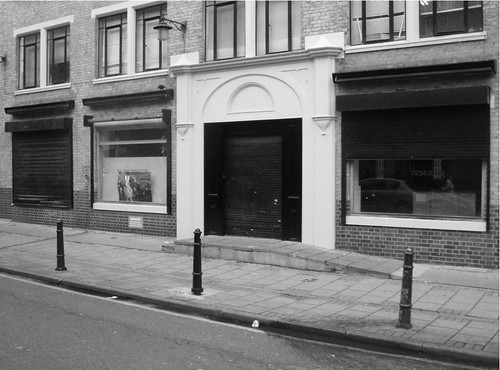
On the downside, it's quite a nuisance to get to - two tube lines plus the infrequently-running London Overground. However, Cafe Oto is the kind of DIY venue that I hadn't been to in London before. Oto takes up the first floor of a converted warehouse in the northeast London neighborhood of Dalston, land of the fried chicken shops it seems. It has a vibe quite similar to 45 Bleecker in New York and caters to the weird and wonderful things that will never make it to Southbank or the Barbican. And last night, it was packed. It was so packed, I was virtually sitting up Darcy's butt.
#2: That first row seat was actually pretty frickin' sweet
During the break, the guy sitting behind me asked, "Are you ok with being that close?" I responded that I'm a drum set player so I'm usually even closer to the sonic onslaught. He then added that it was pretty amazing to have so many musicians in such an intimate space. Very much agreed.
Speaking of sonic onslaught, my big band director in high school once made a particularly weird exhortation that we should make a phalanx of sound. It only made sense to the two people that payed attention in world history (300 didn't come out until next year), but in terms of last night, it's a pretty apt description. Not only were the full ensemble sections fiercely loud, but they were also perfectly ordered and balanced. It was a wonderfully terrifying sonic experience.
It was especially terrifying when Josh Sinton brought his full force to bear on his baritone sax. During the pulsing sections of "Habeas Corpus," I could only imagine how much more potent Steve Reich's Music for 18 Musicians would be if Sinton doubled the bass clarinet parts on bari. During his solo on the new piece "Dymaxion," inspired by the American futurist Buckminster Fuller, the instrument seemed to buckle under the the torrential winds from Sinton's lungs, literally screaming in pain.
The advantage of that seat wasn't just sonic, but visual as well. I had a nearly unobstructed view of Mr. Argue's scores, which excited my super-technical music nerd side. For example, the other new piece on the program was called "Induction Effect," a meditation on how the human brain is so well-programed to disorient itself. The piece began with what was supposed to be a totally disorienting vamp, but I had the inside scoop on how it all was supposed to work. First the bass came in playing a straight triplet pattern in 5/4 time. Drummer Jon Wikan laid down a fat rock beat on top. Then the electric piano played a different repeating figure that suggested a different time signature. And then the guitar added another part that felt totally unrelated to the other three. And the band came in and...
I just lost my place.
#3 The band's collegiality is inspiring
Taking a big band that plays unclassifiable and weird music on the road is definitely a shoestring effort. The only reason the Secret Society was able to come over to England the first place was a grant from the Mid-Atlantic Arts Foundation and the group may still end their trip in the red.
That being said, the only reason that 18 musicians would join up for such endeavor is that they love and believe in the music they're playing. It's one thing when Darcy gets to travel to Europe and do his music with one of the state-sponsored big bands, but it's not quite the same as when the music is played by close friends and colleagues. It was great to see folks like Ingrid Jensen in the trumpet section, Curtis Hasselbring on trombone, and Erika von Kleist leading the saxes. These players (and many more in the band) are leaders in their own rights and could be off working on their own projects, or at least doing more lucrative studio work at home in New York. Instead they chose to travel halfway around the world to play in some old warehouse in a dingy part of town in front of maybe 100 people. If that's not for the love of the game, I don't know what is.
The Secret Society has grown from a pick-up band just a few years ago into a tight-knit group, truly co-creators in this music. The band is more fluent now in Argue's complex musical language, more comfortable in navigating his cruelly difficult solo sections. On "Habeas Corpus," trombonist James Hirschfeld gave it his all, soaring over the insistent background figures and on "Phobos," saxophonist Mark Small gracefully weaved his way through the chord sequence that changes on the whim of Mr. Argue. But more importantly, they've developed a deep sense of camaraderie. Erika von Kleist got a high five from Darcy for her stirring solo on "Obsidian Flow." There were quite a few hoots coming from the band during the collective soloing of Sam Sadigursky and trombonist Mike Fahie on "Jacobin Club." Trumpeter Matt Holman got a hearty applause from his bandmates for somehow navigating through the web of "Induction Effect."
No matter who plays the compositions, Darcy James Argue's music is dark, richly layered, and finely crafted. But it takes the particular talents and commitment of his Secret Society to make it immediate and exciting, something that will stay in the listener's mind well after leaving the show. Here's to the hope that Darcy James Argue will always have the help of a Secret Society to make his music too good a secret to keep.
It's Gordon Goodwin's delightfully candy-shopped version of Miles Davis' "Seven Steps to Heaven," featuring Peter Whitehouse on trombone, Steffan Ciccotti on vibraphone, Toby Street on trumpet, and a little bit of yours truly on those drum breaks at the end.
Speaking of incriminating big band evidence, I was able to see Darcy James Argue's Secret Society on Thursday evening in their (very fringe) London debut. My unyielding loyalty to Argue and his co-conspirators is well-trod, so it doesn't say much that I thought the concert was friggin' unbelievable, even better than when I saw them in New York about a year ago. So instead, here are some comments, musings, and the like from last night's show.
#1: Cafe Oto is a gnarly venue
 |
| Really screams jazz club, doesn't it? |
#2: That first row seat was actually pretty frickin' sweet
During the break, the guy sitting behind me asked, "Are you ok with being that close?" I responded that I'm a drum set player so I'm usually even closer to the sonic onslaught. He then added that it was pretty amazing to have so many musicians in such an intimate space. Very much agreed.
Speaking of sonic onslaught, my big band director in high school once made a particularly weird exhortation that we should make a phalanx of sound. It only made sense to the two people that payed attention in world history (300 didn't come out until next year), but in terms of last night, it's a pretty apt description. Not only were the full ensemble sections fiercely loud, but they were also perfectly ordered and balanced. It was a wonderfully terrifying sonic experience.
 |
| They seem kindly and chill here, but trust me, Leonidas wouldn't wanna mess |
 |
| The Dymaxion Car |
The advantage of that seat wasn't just sonic, but visual as well. I had a nearly unobstructed view of Mr. Argue's scores, which excited my super-technical music nerd side. For example, the other new piece on the program was called "Induction Effect," a meditation on how the human brain is so well-programed to disorient itself. The piece began with what was supposed to be a totally disorienting vamp, but I had the inside scoop on how it all was supposed to work. First the bass came in playing a straight triplet pattern in 5/4 time. Drummer Jon Wikan laid down a fat rock beat on top. Then the electric piano played a different repeating figure that suggested a different time signature. And then the guitar added another part that felt totally unrelated to the other three. And the band came in and...
I just lost my place.
#3 The band's collegiality is inspiring
Taking a big band that plays unclassifiable and weird music on the road is definitely a shoestring effort. The only reason the Secret Society was able to come over to England the first place was a grant from the Mid-Atlantic Arts Foundation and the group may still end their trip in the red.
That being said, the only reason that 18 musicians would join up for such endeavor is that they love and believe in the music they're playing. It's one thing when Darcy gets to travel to Europe and do his music with one of the state-sponsored big bands, but it's not quite the same as when the music is played by close friends and colleagues. It was great to see folks like Ingrid Jensen in the trumpet section, Curtis Hasselbring on trombone, and Erika von Kleist leading the saxes. These players (and many more in the band) are leaders in their own rights and could be off working on their own projects, or at least doing more lucrative studio work at home in New York. Instead they chose to travel halfway around the world to play in some old warehouse in a dingy part of town in front of maybe 100 people. If that's not for the love of the game, I don't know what is.
The Secret Society has grown from a pick-up band just a few years ago into a tight-knit group, truly co-creators in this music. The band is more fluent now in Argue's complex musical language, more comfortable in navigating his cruelly difficult solo sections. On "Habeas Corpus," trombonist James Hirschfeld gave it his all, soaring over the insistent background figures and on "Phobos," saxophonist Mark Small gracefully weaved his way through the chord sequence that changes on the whim of Mr. Argue. But more importantly, they've developed a deep sense of camaraderie. Erika von Kleist got a high five from Darcy for her stirring solo on "Obsidian Flow." There were quite a few hoots coming from the band during the collective soloing of Sam Sadigursky and trombonist Mike Fahie on "Jacobin Club." Trumpeter Matt Holman got a hearty applause from his bandmates for somehow navigating through the web of "Induction Effect."
No matter who plays the compositions, Darcy James Argue's music is dark, richly layered, and finely crafted. But it takes the particular talents and commitment of his Secret Society to make it immediate and exciting, something that will stay in the listener's mind well after leaving the show. Here's to the hope that Darcy James Argue will always have the help of a Secret Society to make his music too good a secret to keep.
Tuesday, November 16, 2010
Blogging the London Jazz Festival - Mid-Fest Update
Tomorrow evening features what very may be the mostly hotly anticipated performance of the London Jazz Festival. Is it the Barbican's double bill of Charles Lloyd and Norma Winstone, featuring new MacArthur Genius grant winner Jason Moran? Of course not! It's the Royal College of Music Big Band playing at the Bull's Head in Barnes.
Alright, I keed, I keed. But this is the one performance where I have to put the money where my mouth is and actually play, rather than just sit back and post snarky comments later. We're doing a particularly old school set, but this isn't some lightly swinging dinner set. There's some Thad Jones, Mingus, the Duke, definitely not background music by any means. Our fearless director, Mark Armstrong, will take some blazing trumpet solos and hopefully we'll get through it all in one piece.
For my London readership (population: less than or equal to 1), come down to Barnes for our 8:30 PM hit. For everyone else, I'm planning to do a bit of bootleggin' and if anything comes out ok, it'll make it's way onto the internets in some capacity. Be on the lookout!
In other news, this guy from BBC radio 3 really liked Gretchen Parlato on Friday. Take notes, Miss Yanofsky.
Alright, I keed, I keed. But this is the one performance where I have to put the money where my mouth is and actually play, rather than just sit back and post snarky comments later. We're doing a particularly old school set, but this isn't some lightly swinging dinner set. There's some Thad Jones, Mingus, the Duke, definitely not background music by any means. Our fearless director, Mark Armstrong, will take some blazing trumpet solos and hopefully we'll get through it all in one piece.
For my London readership (population: less than or equal to 1), come down to Barnes for our 8:30 PM hit. For everyone else, I'm planning to do a bit of bootleggin' and if anything comes out ok, it'll make it's way onto the internets in some capacity. Be on the lookout!
In other news, this guy from BBC radio 3 really liked Gretchen Parlato on Friday. Take notes, Miss Yanofsky.
Sunday, November 14, 2010
Taped Blogging the London Jazz Festival - Sam Crowe Group + Kit Downes Sextet
The Royal Festival Hall was packed on Saturday evening for a concert featuring Herbie Hancock and his ironically titled "Imagine Project". Knowing that the audience, expecting a full-out onslaught of trippy Mwandishi kosmigroov, would be disappointed in Hancock's performance, the promoters threw in a free opening gig in the lobby featuring two British pianists whose best work is in front of them, rather than behind - Sam Crowe and Kit Downes.
There was quite the lively vibe at the hall, with families resting their legs after a big shopping day, old friends conversing over pints, teenagers just there to hang out. I couldn't even grab a seat near the stage, rather electing to stand behind the back row of chairs in plain view of the drums (Even if I didn't like the music that much, I could at least pick up an idea or two). It might not have had the same self-congratulatory optimism at the Undead and Winter Jazz Fests in New York, but there sure were a lot more people, and a lot more different kinds of people. It seems that jazz is a lot less uncool in Britain than in the states. Maybe it's the fact that there isn't this self-important "Jazz is America's classical music" preachiness to it all.
That inherent coolness was embodied by the Sam Crowe group's slick attire (see right) - suit jackets with colorful shirts and jeans, pointy shoes, designer 5 o'clock shadow. They look those "nice boys" your mom always wanted you to date...
Oh wait a sec, haven't I seen this before?
Certainly Django Bates is more than a little too intense and subversive for this category, but Sam Crowe seems to fit the bill quite well. The pianist's harmonic palette is sweetly tonal, not far removed from the likes of Esbjorn Svensson or the American young guns Aaron Parks and Taylor Eigsti. There's no down and dirty swing, no vicious attacks on the piano. Crowe and his group seem content to sit in glossy landscapes, and that can be quite nice, at least for a while.
Although Crowe was working with deps in the drum and vibe chairs, the band sounded tight and surefooted. It was clear they all knew the language of Crowe's music, which makes me wonder if the blend of poppy harmonies and icy even-eighth groove is the young British jazz musician's vernacular. If it is, then I guess it's safe to say that British jazz speaks in a posh accent
But throughout the mostly mild-mannered set, there were some rhythmic sparks. Bassist Jasper Hoiby in particular was never afraid to throw the soloist some slippery curveballs, his big tone penetrating the bustling room. He and Crowe seemed to share quite a few devious smiles when interjecting on a vibes or soprano sax solo. The last tune of the set was quite rhythmically playful and was dedicated to Crowe's nephew Max (don't worry, his niece Phoebe also had a song dedicated to her earlier). It began with a sprightly major-key vamp, leading into a simple song, beguilingly innocent. Everyone got to show off their chops playing over the quick tempo, but it always stayed in character.
As I waited through the stage change, my next review was forming in my head:
 Well, after about five minutes I was scrambling to erase what I had thought and just catch up with what was actually happening. Downes, hair neatly cropped now but still with that beard, came on with significant reinforcements - 2 saxes and a cello - and a different drummer. The band jumped right into a sort of tipsy parlor song, then seamlessly transitioned into a tune both folksy and funky. Downes said afterward that it was inspired by pianist Keith Jarrett's tambourine playing in the 1970s, which he often did with his fantastically off-kilter and vastly underrated "American" quartet. Drummer Tim Giles (on right) perfectly channeled Paul Motian (from Jarrett's band) on the tune with a thuddy sound and impeccable placement. Already, this performance had a much wider trajectory than the one of two months ago.
Perhaps due to his success following his Mercury Prize nomination, Downes seems more willing to take ambitious risks in his music. For example, on the tune "The Wizard," he let saxophonist James Allsop and Giles go for it at the outset before chiming in with deep, dark chords and keyboard-spanning runs. This wasn't your Harry Potter playtime kind of wizard, rather something much more mysterious and druidic. The music here wasn't afraid to ruffle the audience's feathers and was much more engaging for that.
It didn't always mean it was loud, in your face music. On a ballad called "The View," Downes began the tune solo, playing much too softly for a noisy lobby. Yet in a Cagean fashion, the shear quietness of the piano was so unnerving, it was impossible not to pay attention. Throughout the set, Downes and his band played deftly with such contrasts in volume, harmony, timbre, and tempo (or total lack thereof). Although such contrast may suggest a lack of individual vision, the contrasts here showed that Downes does indeed have a personal sound. Everything was united by Downe's careful touch and intense patience. The contrasts belie a multitude of influences, but all integrated into a particular vocabulary that Downes already speaks quite fluently.
Before the last tune Downes mentioned that all the set's music had been recorded by the group and was going to be released on a new album in March of the coming year. If the performance is any indication, this is certainly an album worth looking out for. With the additions to his normal trio, Downes doesn't have to carry the weight of melody and accompaniment all the time. He can be more texturally inventive while backing other soloists and also use the new voices to enrich the variety of his compositions. Downes' music is starting to head down dark and mysterious paths. While that means another Mercury nod is likely not in the cards (it'll be too terribly adventurous for a mainstream prize soon enough), it is clear we can expect great things from this young piano wizard.
There was quite the lively vibe at the hall, with families resting their legs after a big shopping day, old friends conversing over pints, teenagers just there to hang out. I couldn't even grab a seat near the stage, rather electing to stand behind the back row of chairs in plain view of the drums (Even if I didn't like the music that much, I could at least pick up an idea or two). It might not have had the same self-congratulatory optimism at the Undead and Winter Jazz Fests in New York, but there sure were a lot more people, and a lot more different kinds of people. It seems that jazz is a lot less uncool in Britain than in the states. Maybe it's the fact that there isn't this self-important "Jazz is America's classical music" preachiness to it all.
 |
| Don't they look nice! |
That inherent coolness was embodied by the Sam Crowe group's slick attire (see right) - suit jackets with colorful shirts and jeans, pointy shoes, designer 5 o'clock shadow. They look those "nice boys" your mom always wanted you to date...
Oh wait a sec, haven't I seen this before?
Downes, bassist Calum Gourlay, and drummer James Maddren have been playing together since starting at the Royal Academy of Music in London in 2005, and they took the stage with a relaxed politeness. Like those "nice boys" your mom always wanted you to date. Except that Downes has a mighty beard and pony tail.Oh right, I guess I thought the same thing about Kit Downes and his mates when I saw them a couple of months ago. Is British instrumental jazz just "nice boy" music (also considering I haven't seen one female jazz instrumentalist on stage here)?
Certainly Django Bates is more than a little too intense and subversive for this category, but Sam Crowe seems to fit the bill quite well. The pianist's harmonic palette is sweetly tonal, not far removed from the likes of Esbjorn Svensson or the American young guns Aaron Parks and Taylor Eigsti. There's no down and dirty swing, no vicious attacks on the piano. Crowe and his group seem content to sit in glossy landscapes, and that can be quite nice, at least for a while.
Although Crowe was working with deps in the drum and vibe chairs, the band sounded tight and surefooted. It was clear they all knew the language of Crowe's music, which makes me wonder if the blend of poppy harmonies and icy even-eighth groove is the young British jazz musician's vernacular. If it is, then I guess it's safe to say that British jazz speaks in a posh accent
But throughout the mostly mild-mannered set, there were some rhythmic sparks. Bassist Jasper Hoiby in particular was never afraid to throw the soloist some slippery curveballs, his big tone penetrating the bustling room. He and Crowe seemed to share quite a few devious smiles when interjecting on a vibes or soprano sax solo. The last tune of the set was quite rhythmically playful and was dedicated to Crowe's nephew Max (don't worry, his niece Phoebe also had a song dedicated to her earlier). It began with a sprightly major-key vamp, leading into a simple song, beguilingly innocent. Everyone got to show off their chops playing over the quick tempo, but it always stayed in character.
As I waited through the stage change, my next review was forming in my head:
Kit Downes came on next and his set sounded just like it did last time, nice and pretty, blah blah blah...
The end.

Perhaps due to his success following his Mercury Prize nomination, Downes seems more willing to take ambitious risks in his music. For example, on the tune "The Wizard," he let saxophonist James Allsop and Giles go for it at the outset before chiming in with deep, dark chords and keyboard-spanning runs. This wasn't your Harry Potter playtime kind of wizard, rather something much more mysterious and druidic. The music here wasn't afraid to ruffle the audience's feathers and was much more engaging for that.
It didn't always mean it was loud, in your face music. On a ballad called "The View," Downes began the tune solo, playing much too softly for a noisy lobby. Yet in a Cagean fashion, the shear quietness of the piano was so unnerving, it was impossible not to pay attention. Throughout the set, Downes and his band played deftly with such contrasts in volume, harmony, timbre, and tempo (or total lack thereof). Although such contrast may suggest a lack of individual vision, the contrasts here showed that Downes does indeed have a personal sound. Everything was united by Downe's careful touch and intense patience. The contrasts belie a multitude of influences, but all integrated into a particular vocabulary that Downes already speaks quite fluently.
 |
| Who knows what Downes' music will be like next month. It's hard enough predicting his hairdo. |
Subscribe to:
Posts (Atom)